How to Host a Murder Mystery Party for 15–20 Guests
Hosting a MortalCase game for 15 to 20 people is a room problem before it's a casting problem. Once that many guests arrive, the evening depends on how many conversations can happen at once, whether the evidence is somewhere everyone can reach, and how fast you can absorb the cancellations that turn up on the day. Here's how to set all 3 of those up before the doorbell goes, and what to say in the first 5 minutes.
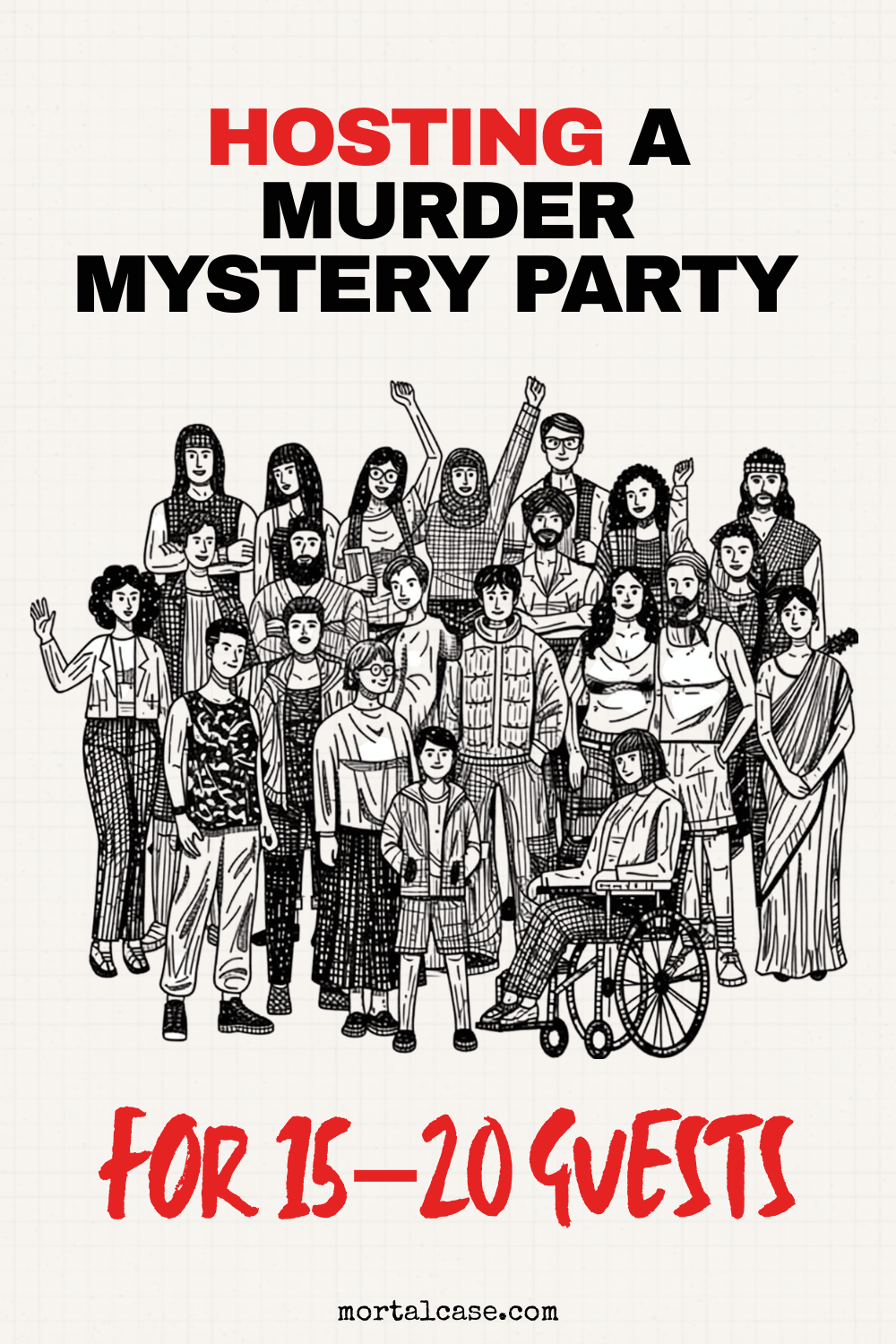
Your guest list crossed 15 people, and the party you were planning turned into a different party. Everyone still needs a character, a conversation to be in, and someone to suspect.
Every MortalCase game holds 20 Character Guides: 8 required Primary Characters who carry the story and the 3 murders, and 12 Secondary Characters you cast as your guest list allows. A group of 15 to 20 uses most of that cast, which is what it’s there for.
At 15 guests, assign all 8 Primary Characters and 7 Secondary Characters. At 20, use all 20 characters. The host may count as one of those players.
I build every game for 8 to 20, and 20 is where I stop, because past that the room splits into parties that can’t hear each other. At the top of the range every guest already has a role, so your work moves from casting to running the room.
Your list got this big for a reason, and if the reason is a 50th, marking a milestone birthday without interrupting the game is the extra decision to make before you start casting.
Confirm the guest count before assigning roles
Set an RSVP deadline and wait for firm answers. Assign the 8 Primary Characters first because the story requires all of them. Then add Secondary Characters until every confirmed guest has a role.
For 15–20 guests, you don’t need to create extra suspects or place anyone in a separate detective category. The Core Game Kit contains 20 full Character Guides. Use the MortalCase player-count guide if your attendance may fall below 15 or rise above 20.
Keep a simple casting list with the real name, character name, email address, and confirmation status. Send each person only their own guide. A shared folder with all character files can spoil relationships and private information.
The practical casting guide can help you match roles to guest comfort while keeping reliability in view.
Build a cancellation plan into the cast
Ask guests to contact you privately as soon as plans change. If a Secondary Character cancels, continue without that role. If a Primary Character cancels, move one Secondary guest into the required role and send the replacement guide.
The 12 Secondary Characters exist for this. I made them optional so a cancellation costs you one guide and nothing else, and so you never have to rewrite a case at 4pm on a Saturday.
For a group this size, choose your first replacement before game day. Pick someone reliable who can handle a new guide without feeling punished for showing up.
Do not combine 2 official characters into one player or rewrite the solution. If you lose several people, the guide to solving common party problems helps you repair the cast while protecting the required roles.
Send character materials early
Large groups need more coordination, so send guides as soon as the cast is stable. Ask every guest to read before the party, keep the material private, and bring a digital or printed copy.
Sending 20 guides individually takes longer than you’d think. I’d rather tell you now than have you find out an hour before the party, so do it in one sitting with your casting list open and check each name twice before you press send.
Tell them they can use the guide during play. Memorization isn’t required, acting skill is optional, and one themed accessory is enough for a costume. These expectations prevent 20 separate worries from arriving at your door at the same time.
Send one shared spoiler-free note with the date, 2.5–3-hour duration, PG-13 tone, arrival instructions, dress guidance, and RSVP-change policy. Keep private character questions in direct messages.
Set up the room for movement
A MortalCase Murder Mystery Party is mingle-style. Avoid placing 20 chairs around one table as the main playing arrangement. Create several open conversation areas with clear walking paths between them.
Guests at Casino Killer – High-Stakes Murder already expect to drift from one table to the next, so you won’t have to explain why the room is laid out in small areas.
Use readable name tags. Place drinks and food away from evidence, and choose items guests can eat between conversations. Keep 1 or 2 chairs available for anyone who wants to review notes without leaving play.
At this size, noise rises quickly. Skip loud background music once the investigation begins, or keep it low enough for ordinary conversation. The soundtrack shouldn’t make every clue exchange sound like negotiations beside a nightclub speaker.
Create one evidence station
Place released evidence on a central table, wall, or counter that everyone can reach. Announce each item, read public wording when directed, and tell guests to return material after looking.
Follow the guide to organizing evidence without spoilers so you can release each item in order without interpreting the solution. Keep Voting Cards and the protected Reveal in a separate host area.
For 15–20 people, evidence can disappear inside a conversation cluster. Re-gather the group briefly for each scheduled release. Then let smaller discussions resume.
Start with structured introductions
Bring everyone together for the welcome and rules. Ask each guest to give their character name and one public fact. Keep introductions short; 20 miniature speeches can consume the first phase.
After introductions, direct guests to one named relationship or first task in their Character Guide. This sends the room into several purposeful conversations instead of one hesitant crowd.
“If I could give this more than 5 stars I would! I hosted 13 teenagers and they had a blast! Now I really want to host this for adults too! Tak!”
The review comes from a 13-player party, but the lesson carries into a larger room: clear structure gives group energy somewhere useful to go.
Keep 15–20 guests circulating
Named relationships and Secret Tasks should do much of the work. If people remain with their usual friends, announce a short goal: question 2 characters outside your current cluster, compare one account, or bring a new theory to someone connected to the latest evidence.
Watch for guests who dominate. Redirect a question to another character, invite a different opinion, or give the energetic player a task that sends them across the room. Do this lightly and early.
Watch for guests who hang back too. Offer one private action rather than calling attention to them. A clue to inspect or named person to find is easier than “join in more.”
Manage time by phase, one mingle period at a time
Use the full party timeline to plan food, evidence releases, murders, voting, and the Reveal. Tell the group when a mingle period is halfway through and give a short warning before the next required event.
Do not wait for every pair to finish. A room of 20 will always contain one fascinating conversation when the schedule needs to move. Announce the transition clearly and allow guests to continue the theory afterward.
If energy is strong, extend a mingle period slightly. If the room is tiring, shorten it or remove optional material. Preserve the murder order and collect all votes before opening the Reveal.
Let voting give everyone an equal ending
Provide one Voting Card per guest and enough pens. Give people quiet time to record a killer and their reasoning. Public accusations are optional; don’t let the loudest theory become the only theory heard.
Collect all cards before the Reveal. With 20 guests, asking a guest to gather the Voting Cards saves time, but the host should keep control of the protected ending.
Awards are optional. If you use them, choose a small set and keep the presentation moving. Celebrate deductions, committed characters, and memorable moments without creating a category that embarrasses someone.
Can the host be one of the 15–20 players?
Yes, the host can play and doesn’t need to know the killer. Follow the spoiler-free Host Guide, prepare event materials in advance, and leave the protected Reveal closed until after voting.
Choose a character that lets you pause for announcements comfortably. Ask another guest to handle a practical task such as greeting late arrivals or watching the evidence station, but don’t give them solution material.
A prepared room makes a large party easier to host from inside the story. Your systems should answer where the clue goes, when the next event begins, and who covers a cancellation before the first guest rings the bell.
Give your whole guest list a character
My games come with 20 Character Guides: 8 required Primary Characters and 12 Secondary Characters you add as the list grows. Pick the theme your friends will enjoy, and you can cast up to 20 people without inventing a single extra suspect.