How Much Prep Does a MortalCase Murder Mystery Party Really Take?
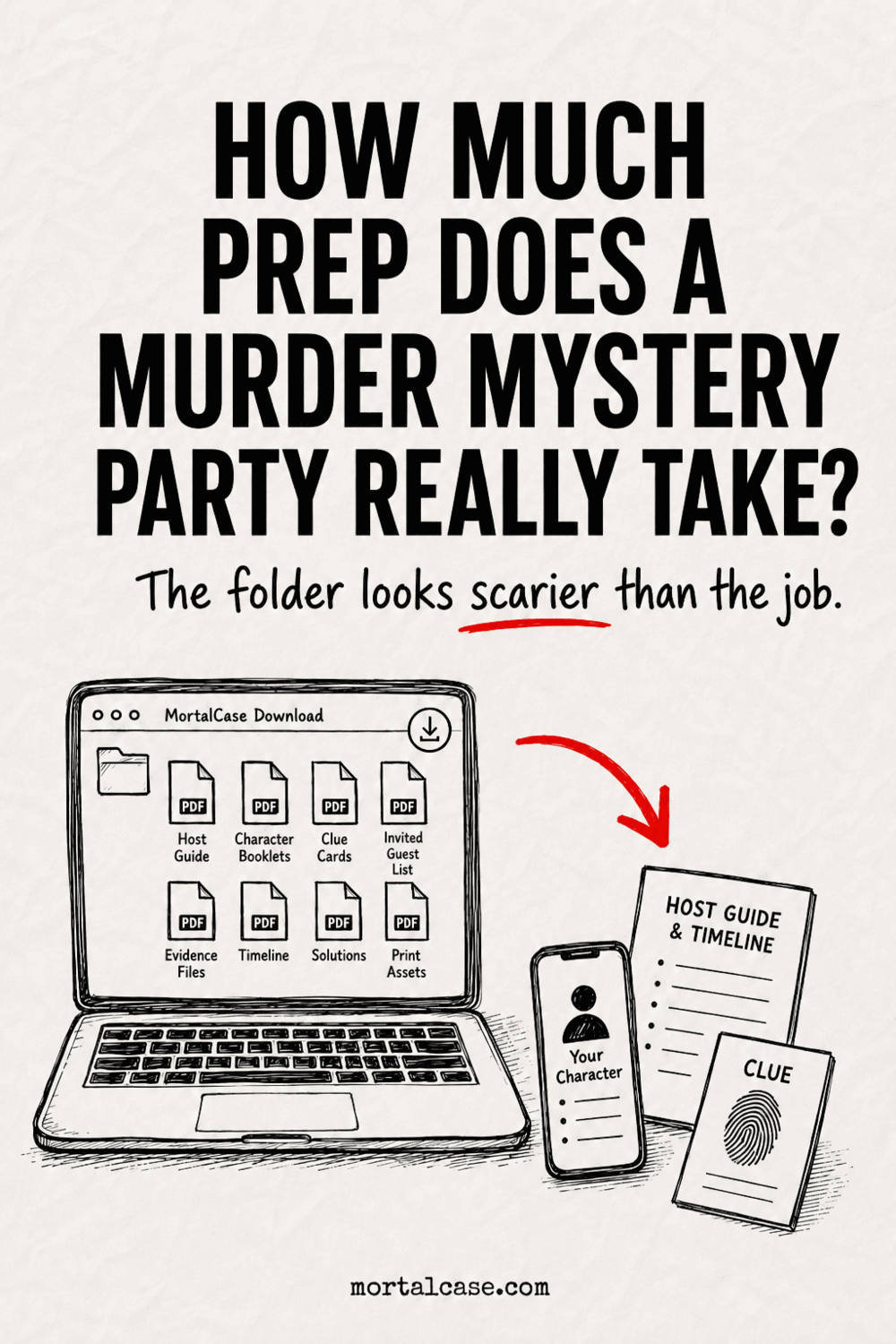
Opening a MortalCase game for the first time can make a perfectly capable host wonder whether she has accidentally volunteered to run a small theater company. The folder contains a lot because the host, the guests, and the final Reveal don't all need the same information. The actual job is much smaller: understand the Host Guide, cast your guests, send their private files, then choose and organize the materials that suit your party. The timeline keeps the evening moving. Nothing needs to be memorized.
“Very responsive and helpful seller, but as a first time party host, the pack was a bit confusing and overwhelming. I don’t think I was aware of the amount of printing and work I was signing up for!”
That review stings a little, because I understand exactly how it happens. You buy a murder mystery because you want the fun part: friends arriving in character, suspicious conversations spreading around the room, someone confidently accusing the wrong person before the first clue has even landed. Then you open the download folder.
There’s a Host Guide. Character Guides. Evidence. Voting Cards. Action Cards. Ghost Cards. Awards. A Reveal you’re absolutely not supposed to read yet. Maybe an Expansion Kit with even more tempting things inside. Suddenly the party you pictured has become a collection of PDFs staring back at you. So let me make one thing clear before we go any further:
You aren’t expected to print everything, use everything, or learn the game by heart.
A MortalCase Core Game Kit already contains the complete murder mystery. I’ve written the story, built the characters, connected the evidence, planned the order of the evening, and prepared the final Reveal. You aren’t sitting down with a blank page and inventing a murder. Your job is to prepare that finished game for your particular group. For most hosts, that means 4 separate bits of work rather than one enormous prep marathon:
- Read the Host Guide once, then keep the timeline beside you during the party.
- Wait for reliable RSVPs, assign the characters, and send each guest their own private Character Guide.
- Choose which optional parts will genuinely help your group and leave the rest alone.
- Print and organize the materials you have decided to use.
That’s the honest answer to how much prep a MortalCase murder mystery takes. I can’t turn it into one universal number of minutes, because your choices matter. A host who sends all guest material digitally and uses a simple evidence setup has a very different project from a host who recreates every printable clue as a physical prop and converts the dining room into a 1970s nightclub. Both can create a brilliant party. Only one of them will be covered in glitter at midnight.
Why the folder looks bigger than the job
I separate the game into different files for a reason. Your guests should receive their own private Character Guides. You need host instructions and a timeline. The group needs evidence at specific moments. The final solution needs to stay hidden. Optional materials need to be easy to leave out without affecting the main mystery. Putting all of that into one giant document would make the folder look smaller, but hosting the game would be much worse. The separate files let you decide:
- What guests receive before the party
- What stays with you
- What can remain digital
- What deserves to be printed
- What you want to use
- What you would rather skip
The Core Game Kit is complete on its own, but it still gives you choices. Action Cards can encourage more interaction. Evidence Logs can help guests who love taking notes. Ghost Cards can make the rules easy to remember after a character dies. Awards can give the ending one last laugh. Some evidence may be optional. Those pieces are included because groups are different. A room full of confident friends who will happily improvise accusations doesn’t need the same support as a group attending its first murder mystery and wondering when they’re allowed to lie.
More files give you more control. They don’t automatically give you more homework. The separate Expansion Kit adds another layer of choices, and every Expansion Kit contains the same things: Character Prompts, extra evidence, Gossip Notes, alibis, more Action Cards, Detective material, and party extras. You may use the parts that solve a problem for your group. You don’t earn a better-host badge for using every page.
Start with the experience you want, not the files you received
Before you print anything, picture your guests. Are they the kind of people who will walk in, read one paragraph about their character, and immediately begin causing problems? Or will they feel safer with an extra prompt telling them who to approach and what to bring into the next conversation? Do they love examining every clue? Or are they here mostly for costumes, accusations, and the pleasure of watching Uncle Mark defend an extremely suspicious alibi? Your answers decide which optional pieces deserve a place at the party.
For a first-time group, I usually prefer a setup that feels clear rather than crowded. I would keep the evidence visible, read short written clues aloud, make sure every guest understands their Character Guide, and add only the optional elements that solve a real need. That might mean a few Action Cards for guests who need help starting conversations. It might mean an Evidence Log for the friend who has already arrived with 3 pens. It might mean no extras at all because your guests are perfectly capable of creating their own chaos. The mystery doesn’t become incomplete because you leave an optional file in the folder. It becomes yours.
December is where this pays off. Who Killed Santa’s Wife? puts your guests in the room after a long day of eating, when very few of them have patience left for extra pages.
Your first job is smaller than it sounds
“Read the Host Guide” can sound like the beginning of an exam you didn’t sign up for. It isn’t.
The Host Guide explains how the game works. The timeline gives you the order of the important moments in a format you can keep beside you during the party. You aren’t expected to remember when each murder happens, when evidence appears, or when everyone votes without checking.
Read the guide once when you have enough peace to understand the basic flow. Find the timeline. Open the host materials it refers to so you know what they look like. Notice which files are marked as spoilers, then leave those files closed if you want to investigate with everyone else. That first read is about familiarity, not mastery. By the end, you should know 3 things:
- What you need to do before guests arrive
- Which moments you’ll guide during the party
- Where to look when you need the next step
You don’t need to read every private Character Guide. The spoiler-free Combined Character Bios are there to help you cast the guests without uncovering all their secrets. You also don’t need to direct the evening like a stage manager with a headset.
Nobody hands you the solution when you take the host’s chair, and whether the host has to know the killer before the party settles the rest of that worry.
The timeline keeps the main events moving. The guests handle the suspicious conversations, secret hiding, accusations, alliances, and increasingly questionable detective theories.
Casting is mostly a guest-list problem
The Core Game Kit includes 8 required Primary Characters and 12 optional Secondary Characters, and you decide how many of the 12 you use. Assign the Primary Characters first. Then add Secondary Characters until everyone has a role.
The Combined Character Bios give you enough information to make sensible matches without opening the full private guides. You can give a larger, more dramatic role to someone who will enjoy the attention and a gentler role to the guest who wants to participate without delivering a monologue on the coffee table. The actual casting is usually straightforward. The guest list is the part with opinions.
People say yes before checking their calendar. Someone assumes their partner is included. One guest cancels. Another appears from nowhere 3 days before the party and is apparently now bringing a cousin. This is why I recommend setting an RSVP deadline and waiting for a reasonably firm number before assigning roles.
Once the cast is settled, send each guest their own Character Guide privately. They can read it on a phone or another personal device and keep it nearby during the game.
You may print the guides if that works better for your group. You don’t need to create 20 stapled character dossiers simply because you own a printer and have temporarily lost perspective.
Choose the optional pieces with a reason
Optional doesn’t mean pointless. It means you get to decide whether that element earns a place at your party. Here’s how I think about the most common choices.
Action Cards
Action Cards give a guest something new to do. They can start a conversation, stir up suspicion, create an alliance, or add a little chaos when the room needs it. They’re especially useful when some guests enjoy the idea of freeplay but need a nudge once they’re standing in the room.
They aren’t evidence, and the game doesn’t depend on them. A confident group may barely need them. A quieter group may appreciate a few carefully chosen cards more than a giant self-serve stack.
Evidence Logs
Evidence Logs are for the guest who wants to write down what the clue is, who it points toward, and why it might matter. Some people love this. You know exactly who they are. Other guests will abandon the sheet after 2 minutes because they’re busy interrogating the person near the snacks. Both approaches are allowed.
Optional evidence
Extra clues can give deduction-focused guests more to work with. They also create more information for the room to remember.
Use them when your group enjoys that challenge. Leave them out when the main evidence already gives your guests enough to discuss.
More evidence isn’t automatically a better mystery night. Sometimes it’s simply more paper being waved at Uncle Mark.
Ghost Cards and awards
Ghost Cards explain how a guest continues after their character dies. You may print the cards, or you can explain the rules yourself.
Awards can be a fun final beat, especially for best costume or most in character. They aren’t part of solving the case. If you’re tired by the time you reach the awards file, nobody will report you to the murder mystery authorities.
The Expansion Kit
The Expansion Kit is for hosts who want more ways to shape the experience. Character Prompts can give guests a short introduction and a clear next action after each murder. Extra evidence can deepen the deduction. Gossip Notes, alibis, and additional Action Cards can add fresh conversation. Detective material can support extra guests who are investigating without becoming suspects. Party extras can help with the theme around the game. That doesn’t mean the obvious choice is to use all of it. Choose the pieces that answer a question you already have. “My guests are shy” may point toward Character Prompts. “My group loves complicated clues” may point toward extra evidence. “I have more guests than character roles” may point toward Detectives. “I want the room to feel more themed, but I don’t want to design everything myself” may point toward the party extras. A file that doesn’t help your group can stay where it is.
What should you actually print?
This is where most first-time hosts expect a frightening answer. The practical answer is much kinder.
| Material | My usual recommendation | Why |
|---|---|---|
| Invitations and spoiler-free pre-party material | Send digitally | Guests get the information without creating another printing job. |
| Character Guides | Send digitally | Each guide is private, and guests can keep it on their own device. |
| Host Guide | Read digitally or print the pages you prefer | Choose the format that feels easiest while preparing. |
| Timeline and Host Scripts | Print them or keep them open on a reliable device | You need quick access at the right moments. |
| Evidence | Print the pieces you have chosen to use | Physical clues are easy to display, inspect, and pass around. |
| Evidence Logs | Print only for guests who will use them | They’re helpful for note-takers, not required for everyone. |
| Ghost Cards | Optional to print | You can hand out the cards or explain the Ghost rules aloud. |
| Voting Cards | Print 1 per guest | Everyone records a private accusation before the Reveal. |
| Awards | Optional | They add a fun ending, not a necessary game step. |
| Expansion Kit materials | Print only the additions you selected | The Expansion Kit is designed to be mixed and matched. |
Please don’t open the folder and hit Print All. That button isn’t your friend.
Print the pieces guests need to inspect, handle, write on, or receive at a specific moment. Keep the rest digital unless a physical copy makes your own hosting easier.
Evidence is usually where paper adds the most value. Guests can gather around a clue, pick it up, compare details, and point at the exact thing that has just destroyed someone’s alibi.
A Character Guide is private. It works perfectly well on the guest’s phone.
A pile of evidence isn’t an organization system
Once you know what you’re using, sort it in the order it will appear. This doesn’t require a color-coded filing cabinet.
A few folders or envelopes can do the job. Group the evidence by murder or event. Keep Voting Cards together. Put the Reveal somewhere safe and easy to find later. Keep the timeline and Host Scripts with you. Label materials by the moment you need them. “After Murder 1” will help you on party night. “Evidence Pack Page 7” will make you stare at the folder as though it has betrayed you personally. Your setup is finished when you can find the next item without searching through the entire download while a room full of suspects watches you panic. It doesn’t need to look impressive on Instagram. It needs to work with one hand while you’re holding a drink in the other.
Where the prep quietly becomes a much bigger project
The game preparation itself has an edge. You can finish it. The party layer is where the work can expand forever.
You may decide to create real versions of printable props. Design food labels. Build a photo wall. Make themed drinks. Cover the room in evidence tape. Age every sheet of paper. Provide elaborate costume accessories. Rewrite your home as an immersive crime scene. That can be wonderful if this is the part you love. It isn’t required to rescue the game from looking unfinished.
The printable evidence is already evidence. The supplied story is already the story. The party can take place in a normal home with food people want to eat. I would rather see you prepare the cast and organize the evidence than spend 4 hours making a decorative sign while the Character Guides remain unsent. Finish the mystery first. Then look at your time, energy, budget, and tolerance for craft glue. Add the extras that still sound fun.
The setup I would choose for a first MortalCase party
For a first-time host, I would keep the mystery complete and the choices calm. Read the Host Guide once and print the timeline. Wait for firm RSVPs, assign the 8 Primary Characters first, add the Secondary Characters you need, and send every Character Guide digitally. Show the main evidence to the whole group, read short written clues aloud, and sort the printed evidence by murder. Print 1 Voting Card per guest.
Skip custom evidence. Add a small number of Action Cards only if you expect some guests to need help getting started. Character Prompts from the Expansion Kit suit a hesitant group, and there’s no need to pile every other expansion element around them.
First-time hosts usually want the running order rather than the reasoning behind it, and preparing for your first MortalCase murder mystery party takes it step by step, from the Host Guide to the first 10 minutes.
I would choose 1 or 2 theme details that create atmosphere without creating a second event-planning job. A playlist. Lower lighting. One good photo area. Done. That gives you the full story, the characters, the evidence, the murders, the vote, and the Reveal. Nobody leaves disappointed because the awards weren’t printed on heavyweight cardstock.
That setup assumes you have never hosted a murder mystery party before, which is the position most people are in the first time.
“I had never hosted one of these before. Instructions were easy to follow.”
How to know the mystery is ready
Before guests arrive, ask yourself:
- Has every required Primary Character been assigned?
- Does each guest have the correct private Character Guide?
- Have I chosen the optional elements I want?
- Is the evidence grouped in the order I will use it?
- Can I reach the timeline, Host Scripts, Voting Cards, and Reveal quickly?
5 yeses, and the mystery is ready. The room may still need snacks. Someone will probably message you about their costume. Your printer may decide magenta is a personal boundary. Those are party problems. You have solved the murder mystery problem.
Once guests arrive, you introduce the game and use the timeline to guide the important moments. You don’t need to patrol every conversation or make sure each guest says the “right” thing. The Character Guides, relationships, secrets, tasks, and evidence give them material to work with. They will take it from there. Some will investigate seriously. Some will form an alliance based on absolutely nothing. Someone will accuse the most dramatic person in the room because “they just seem guilty.” You get to watch the party you prepared become theirs.
How much prep does it really take?
A MortalCase murder mystery isn’t an instant-play card game. You need to read the Host Guide, cast the guests, send their files, choose your optional elements, and organize the physical materials you plan to use. You’re also not creating a murder mystery from scratch.
The plot is written. The characters exist. The evidence connects. The timeline is ready. The ending is waiting in the spoiler folder. Your work is to turn that finished game into the version that fits your guests.
Keep the guest files digital. Let the timeline carry the sequence. Print with a purpose. Add optional elements because they help, not because they exist. Finish the mystery before you disappear into decorations. Then stop preparing. The suspects are coming.
You can absolutely handle this.
Find the mystery you actually want to host
Now that you know what the preparation looks like, the next decision is much more fun. Browse the MortalCase murder mystery games and choose the story, cast, and theme your group will want to spend the evening inside.