Can Teens and Adults Play the Same Murder Mystery Game? What Adult Hosts Should Know
As the adult host, you're the one deciding whether teens and adults play the same Murder Mystery Game. Teens ages 13 and older can play when an adult reviews the chosen PG-13 story, hosts actively, and adapts the support to the group. This guide covers theme fit, freeplay confidence, casting, phone rules, evidence, pacing, quiet voting, and mixed-age dynamics while explaining why one successful teen party can't guarantee that every game suits every teenager.
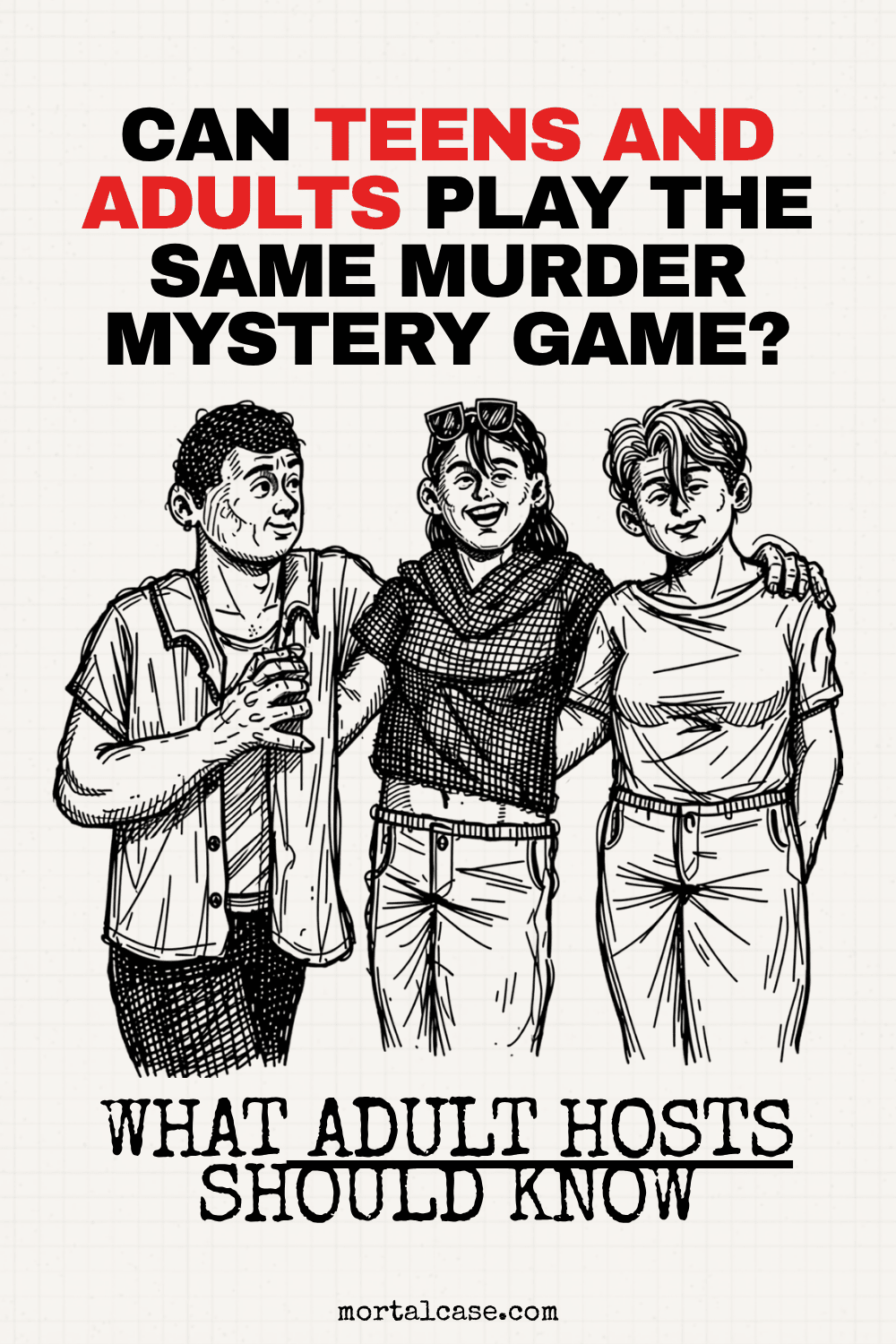
MortalCase Murder Mystery Games can work for teens ages 13 and older and adults in the same group when an adult hosts, reviews the chosen story, and keeps the game moving. The games are made primarily for adult friend groups and family parties, so “PG-13” is a starting point for judgment, not a promise that every theme fits every teenager.
The adult host decides whether the specific story suits the specific guests. Murder, death, secrets, motives, suggestive references, and theme details can land differently across families. Read the current product description and content guidance before sending invitations.
Age is only one part of the fit
2 15-year-olds can have very different comfort with improvisation, dark humor, reading, and public attention. The same is true of adults. A mixed-age party works best when the host looks at the invitation list as people rather than treating an age label as a complete personality profile.
Ask whether guests will read a Character Guide, speak to people outside their usual pair, keep private information private, and stay with a 2.5–3 hour story. The honest quiz on whether a murder mystery fits your group helps you decide.
A successful teen review is a real example, not a universal result. One host put it this way.
“We used this for my son’s 16th birthday. The kids were so into character. We also purchased the expansion pack.”
That party shows what can happen with a willing group; it doesn’t make every cast or theme interchangeable.
I design these for adults. Older teenagers can absolutely join a party, and enough of you have told me you were running one for exactly that group that every game now ships with a bonus host guide called Adults Hosting for Teens. It exists because my reviews and messages said it should, not because the games changed audience.
Review the theme before assigning characters
Every current MortalCase Murder Mystery Game uses a PG-13 rating, and only A Killer Disco Party has a Clean Game Kit. A Clean Game Kit isn’t something every game has. If cleaner language or altered references are essential, confirm that exact option rather than assuming another theme can be converted.
In A Killer Disco Party the Clean Game Kit takes the drug and alcohol references out of the evidence, so your teens still get the romance, the jealousy and the mystery.
Read the hosting guidance and the current listing first. Consider the youngest guest, family expectations, the occasion, and whether any story element needs a private conversation with a parent or participant.
Do not surprise a teen with content you would have screened in a movie. The role remains private, but you can still assess the public premise and general content before you buy.
Freeplay needs clearer support, and no new script
Guests don’t memorize lines. They mingle using character information, relationships, motives, and tasks. Teen players may benefit from a shorter explanation of how to begin: introduce yourself in character, ask one relevant question, share information deliberately, and return to the evidence when the room gets noisy.
They don’t need an accent, a full costume, a dramatic performance, or confident improvisation from the first minute. The Character Guide provides enough material to start. A host can privately encourage a hesitant guest without making that person the center of the room.
The guides to supporting socially anxious guests and murder mystery parties for introverts apply to teens and adults alike.
Cast for comfort and reliability
Every game has 8 required Primary Characters and 12 optional Secondary Characters. Assign the Primary roles to guests who are likely to attend, read, and participate. Primary doesn’t mean “best actor.” It means the story needs that character present.
Use the spoiler-free character overview to match confidence, reading comfort, relationship dynamics, and preferred attention level. The practical guide to assigning the right character to each guest helps you avoid handing the loudest role to the quietest person merely as a challenge.
Mixed ages can be useful. Adults can model how to approach someone, compare clues, and keep the conversation playful. They shouldn’t solve everything aloud before teens have time to contribute.
A 40th or a 60th brings that same range into one room, and choosing a murder mystery for a milestone birthday means matching the game to the birthday person and to everybody they invited.
Make evidence public and pacing visible
Teen groups often benefit from one clear evidence area, direct transition announcements, shorter empty gaps, and specific deduction questions. Ask what changed, whose story conflicts, and which fact supports the current theory. Those questions guide attention without giving away the solution.
Set phone expectations before play. Guests may need a phone for their Character Guide, but unrelated scrolling can remove information from the room. Choose whether files are digital or printed, explain the rule once, and apply it to adults too.
An adult host can play a character too, without ever having read the ending. An adult can investigate with the group while still watching pace, evidence access, and comfort. Choose a co-host if food, arrivals, or supervision would split attention too far.
Protect a calm ending
Before voting, give everyone quiet time to review evidence and form an individual answer. A loud group theory can make less confident players abandon their own reasoning. Private voting lets teens and adults participate without defending every thought in public.
Read the Reveal as written and keep the solution fixed. Wrong guesses are part of the game. The goal is a shared night of character, conversation, and deduction, not proving which age group is smarter.
For a broader family occasion, the guide to mixed-age family murder mystery parties helps you coordinate generations, food, and expectations around the same event.
A simple mixed-age host checklist
- Confirm that every participant is at least 13 and that an adult is hosting.
- Review the exact theme, PG-13 content, and current product description.
- Assign the 8 required Primary Characters to reliable guests.
- Send private Character Guides early and explain freeplay in plain language.
- Choose one evidence area and one transition signal.
- Set phone, food, and quiet-voting expectations for teens and adults alike.
- Leave the Reveal unopened so you can play without spoilers.
Mixed-age play works best when adults support the room without treating teens as junior spectators. Give everyone access to evidence, time to speak, and permission to participate at a comfortable level. If the group needs heavy modification to every part of the story, choose another theme or activity instead of stretching a poor fit.
When adults and teens play together, explain that the mystery is cooperative and competitive at the same time. Everyone shares the same story and evidence, but each person forms an individual theory. Adults should avoid correcting roleplay style, demanding eye contact, or turning every conversation into instruction. Teens should receive the same respect for private character information and their own deductions.
If the youngest guests aren’t ready for the content or the social format, wait. A later party with a willing cast is better than using a birthday milestone as proof that the group should be ready.
Give the group one final reminder: characters can lie about their own secrets, but players shouldn’t invent evidence or change the official story.
Want to see the finished party experience?
Browse MortalCase Murder Mystery Games for 8–20 players and compare the themes, characters, evidence-based freeplay, and host materials.