What to Wear to a Murder Mystery Party: A Guide for Every Theme
Nobody at a MortalCase murder mystery is being judged on their outfit, and 1 clear item is enough. Your Character Guide already points at most of the answer: a hat, gloves, a badge, a jacket that suggests money you can't explain. Guests who want to go further will, without being asked. The point of dressing up is to help you believe the room, not to win it.
The first costume question usually arrives before the character assignments are even finished. “What am I supposed to wear?”
One guest has already opened 6 shopping tabs and is considering a wig that requires its own storage box. Another is hoping “murder mystery” means she can wear black jeans and look thoughtful near the evidence. A third wants to know whether the outfit must match the decade, the job, the personality, or all 3. As the host, you don’t need to become a costume designer for 20 people.
A good murder mystery outfit needs to do only 3 things: feel comfortable enough for a full evening, give a clear signal of the party theme, and help the guest recognize their character.
It doesn’t need to be historically perfect. It doesn’t need to look as though the guest has just stepped out of a professional production.
A MortalCase party is freeplay and mingle-style. Guests move around the room, speak in small groups, examine evidence, protect secrets, and build theories. The best costume helps them enter that world without making it difficult to walk, talk, read, carry a drink, or quietly accuse someone beside the snack table. That gives you a much more useful goal than “everyone must dress up.”
Start with the character, not the costume shop
When a guest receives a Character Guide, the role already gives them several places to begin:
- The character’s role or occupation
- The personality descriptors and Biography
- The setting and time period
- The optional Prop Suggestions
- The kind of attention the guest wants to attract
A 1970s backup dancer and a 1970s music executive belong at the same party, but they shouldn’t automatically look identical. A casino bartender, a wealthy guest, and a security character may all fit the same theme through completely different outfits. This is where a character costume becomes more useful than a generic theme costume. Ask the guest to choose one question:
- What would this character wear to work?
- What would this character wear when trying to impress the room?
- What would this character grab when arriving late?
- What single detail would make another guest understand the role quickly?
The answer might be a jacket, a clipboard, a dramatic necklace, a name badge, a pair of gloves, a camera strap, or a color choice. It doesn’t need to become a full theatrical transformation. I would rather see a guest arrive comfortable, confident, and ready to mingle in a simple outfit that suits the role than spend the first hour adjusting a costume she is afraid to sit down in.
“Fun game! We played it on New Year’s Eve. We all dressed in characters. We enjoyed it a lot!”
Everybody dressing up is the version that works best, and it happens when the brief is easy enough that nobody has an excuse not to. A guest list where half the room dressed up and half didn’t is almost always a brief problem rather than a guest problem.
Tell guests exactly how much costume effort you expect
“Dress for the theme” sounds clear to the host and surprisingly vague to everyone else. Does it mean a complete period costume? A party outfit in the right colors? One accessory? Is dressing up optional, gently encouraged, or the main event? Tell guests before they begin planning. I like giving 3 possible effort levels:
Use what you already own
Start with an ordinary outfit that matches the character’s energy. Add a color, texture, hairstyle, or small item that points toward the theme. This is the right option for guests with limited time, limited budget, sensory needs, costume reluctance, or no interest in buying something for one evening.
Add one clear statement piece
Use a hat, jacket, mask, pair of glasses, jewelry, scarf, gloves, wig, suspenders, themed badge, or simple prop to make the idea obvious. One strong choice usually works better than 6 tiny accessories that disappear in photos and have to be carried around all night.
Build the full character look
Combine clothing, hair, makeup, accessories, and props for the guest who genuinely enjoys going all in. The important phrase is genuinely enjoys. A detailed costume can be wonderful. It isn’t a better way to play the character than listening, sharing information, and following the relationships in the guide. You can put the expectation directly in the invitation:
Costumes are encouraged, but they don’t need to be elaborate. Use something you already own, add one theme-inspired detail, or create a full character look if that sounds fun to you. That sentence gives the costume enthusiast permission to have a spectacular evening and gives everyone else permission to arrive without panic-buying sequins.
Use the 3-piece murder mystery outfit formula
When someone still doesn’t know what to wear, give them this formula:
- Choose a comfortable base outfit.
- Add one clear theme signal.
- Add one character clue.
1. The comfortable base
This is the clothing the guest could happily wear for several hours. It might be a dress, suit, jeans, trousers, skirt, blouse, button-down shirt, jumpsuit, or simple black outfit.
The base doesn’t need to carry the whole costume. It gives the guest something reliable underneath the theme.
2. The theme signal
This tells the room where and when the party belongs. For a disco party, it could be metallic fabric, flared trousers, a wide collar, or bold sunglasses. For a speakeasy, it could be suspenders, a beaded headband, a vest, or long gloves. For Halloween, it could be a cape, mask, ears, dramatic makeup, or one unmistakably monstrous detail. An 80s guest hits the same note with neon, high-tops, or a slogan tee, and how an arcade party gives costumes a direction shows the rest of that brief.
3. The character clue
This tells the room who the guest might be inside that setting. A journalist can carry a notebook. A photographer can wear a camera strap. A bartender can add an apron or towel. A socialite can choose sharper jewelry. A technician can use a work shirt, badge, or small tool pouch. A performer can lean toward stage-ready color and movement.
The character clue doesn’t have to be literal. It gives the guest a small physical way to inhabit the role. With these 3 pieces, a basic outfit stops feeling random without becoming a project.
Choose comfort for a party that moves
A MortalCase party isn’t designed around guests sitting at one table for the full game. They will stand, walk, turn, lean over evidence, check a Character Guide, speak quietly with one person, gather with the whole room, and possibly make an energetic defense of an extremely suspicious alibi. Before approving an outfit, ask:
- Can I walk through a crowded room in it?
- Can I see and hear clearly?
- Can other guests understand me?
- Can I use my phone or hold a printed guide?
- Can I examine evidence without knocking over half the table?
- Will I still want to wear this after the first hour?
Large wings, trailing fabric, vision-blocking masks, unstable shoes, oversized hats, and enormous props can look excellent for one photograph and become a problem for everyone around them immediately afterward. There’s usually an easier version.
Use smaller wings. Lift the mask when speaking. Bring comfortable shoes. Choose a shorter cape. Replace the giant prop with a badge, label, or handheld version. Keep anything sharp, breakable, realistic enough to alarm someone, or difficult to carry out of the party.
The costume should support the evening. The evening shouldn’t become a support system for the costume.
What to wear to a 1970s disco murder mystery party
A 1970s disco theme gives guests permission to use movement, shine, color, and a little glorious excess. Useful starting points include:
- Flared trousers or wide-leg pants
- Jumpsuits, wrap dresses, or flowing sleeves
- Wide collars and open-neck shirts
- Metallic, satin, sparkle, or bold prints
- Platform-inspired shoes that are still comfortable
- Large sunglasses, scarves, hoops, or statement jewelry
Then match the character. A performer can go brighter. A music executive can look polished. A bartender or technician can use a more practical base with one unmistakable disco detail. A photographer or journalist can carry a small role-specific prop.
A Killer Disco Party works well with costumes because the roles already belong inside the music, nightlife, and celebrity world. Guests don’t need identical bell-bottoms. They need to look as though they attended the same suspicious party for different reasons. Sequins do a lot of the work here, so the guest who already owns something shiny is dressed for A Killer Disco Party before she’s decided anything else. If you haven’t planned the rest of the night yet, my guide to a 1970s disco murder mystery party picks up where the outfits stop.
What to wear to an 80s arcade murder mystery party
An 80s arcade look can be built from bright color, strong shapes, sporty pieces, and accessories that are slightly louder than necessary. Try:
- Denim, graphic tees, tracksuits, or windbreakers
- Leather or oversized jackets
- Leg warmers, sweatbands, visors, or high-top sneakers
- Bold earrings, sunglasses, scrunchies, or bright belts
- Color blocking, neon accents, or black with one electric color
For GAME OVER, the arcade role matters as much as the decade. An owner, technician, champion, journalist, investor, and tournament organizer can all use the same 1980s vocabulary without becoming the same costume.
The easiest version is jeans or black trousers, a simple top, comfortable shoes, and one strong arcade-era accessory. The guest who loves costumes can add hair, makeup, layers, and a more complete silhouette.
What to wear to a rock ‘n’ roll murder mystery party
A rock ‘n’ roll theme works best when guests think in character types rather than dressing every person like the lead singer. Useful pieces include:
- Black denim, leather-look jackets, boots, and band-inspired tees
- Sequins, metallic details, animal prints, or dramatic sunglasses
- Statement belts, scarves, chains, layered jewelry, or fingerless gloves
- Sharper tailoring for managers, executives, journalists, or wealthy guests
- Practical dark clothing for security, crew, technicians, and backstage roles
Murder at the Rock’n’Roll Afterparty gives guests a backstage world full of performers, industry people, and the characters orbiting them. The costume becomes more interesting when everyone doesn’t compete to be the loudest person in the band.
Let the star look like a star. Let the manager look polished and tired. Let the crew look as though they have solved 3 technical disasters before the party even started. Once the looks are settled, the room still has to work, and hosting a rock ‘n’ roll murder mystery party deals with the volume problem a band-themed night creates.
What to wear to a casino night murder mystery party
Casino clothing can range from relaxed card-room style to full evening glamour. Tell guests which direction you want before they choose. Easy options include:
- A dark dress, jumpsuit, suit, vest, or button-down shirt
- Red, black, gold, silver, or jewel-tone accents
- Statement jewelry, cuff links, gloves, bow ties, or sleek sunglasses
- A dealer-style vest, bartender apron, security badge, or guest pass
- Playing-card, dice, chip, or money details used lightly
Casino Killer – High-Stakes Murder doesn’t require every guest to arrive in formalwear. A bartender, gambler, owner, employee, performer, and wealthy visitor should feel as though they belong in the same casino without sharing one dress code. Choose one level for the whole party, then let the roles create the variation: casual casino, cocktail casino, or glamorous high-stakes night. Once you’ve settled the dress code, the room is the next decision, and I walk through it in my guide to a casino night murder mystery party. Guests who are given one clear direction about the dress code tend to arrive already in character.
“I definitely recommend this murder mystery kit! My guests showed up dressed in character. We had an AMAZING time!”
What to wear to a 1920s speakeasy murder mystery party
A speakeasy theme becomes much easier when guests focus on shape and detail rather than perfect historical reconstruction. Possible starting points include:
- Straight or dropped-waist dresses, fringe, beads, or art-deco jewelry
- Vests, suspenders, bow ties, waistcoats, or dark suits
- Long gloves, headbands, cloche-inspired hats, or simple hair accessories
- Newsboy caps, pocket watches, notebooks, or discreet flask-style props
- Black, cream, deep red, emerald, navy, gold, and silver
The 1920’s Speakeasy Murder Mystery has room for staff, performers, powerful guests, and people who look as though they know where the hidden entrance is. A simple modern outfit can work with one period-inspired silhouette or accessory.
Avoid making “flapper” the only answer. The room becomes more convincing when guests look like different people from the same secret nightlife world. A host who has already decided what the entrance looks like writes a much easier dress code, and hosting a 1920s speakeasy murder mystery party covers that door, the lighting, and the wording to send with the invitation.
What to wear to a Halloween murder mystery party
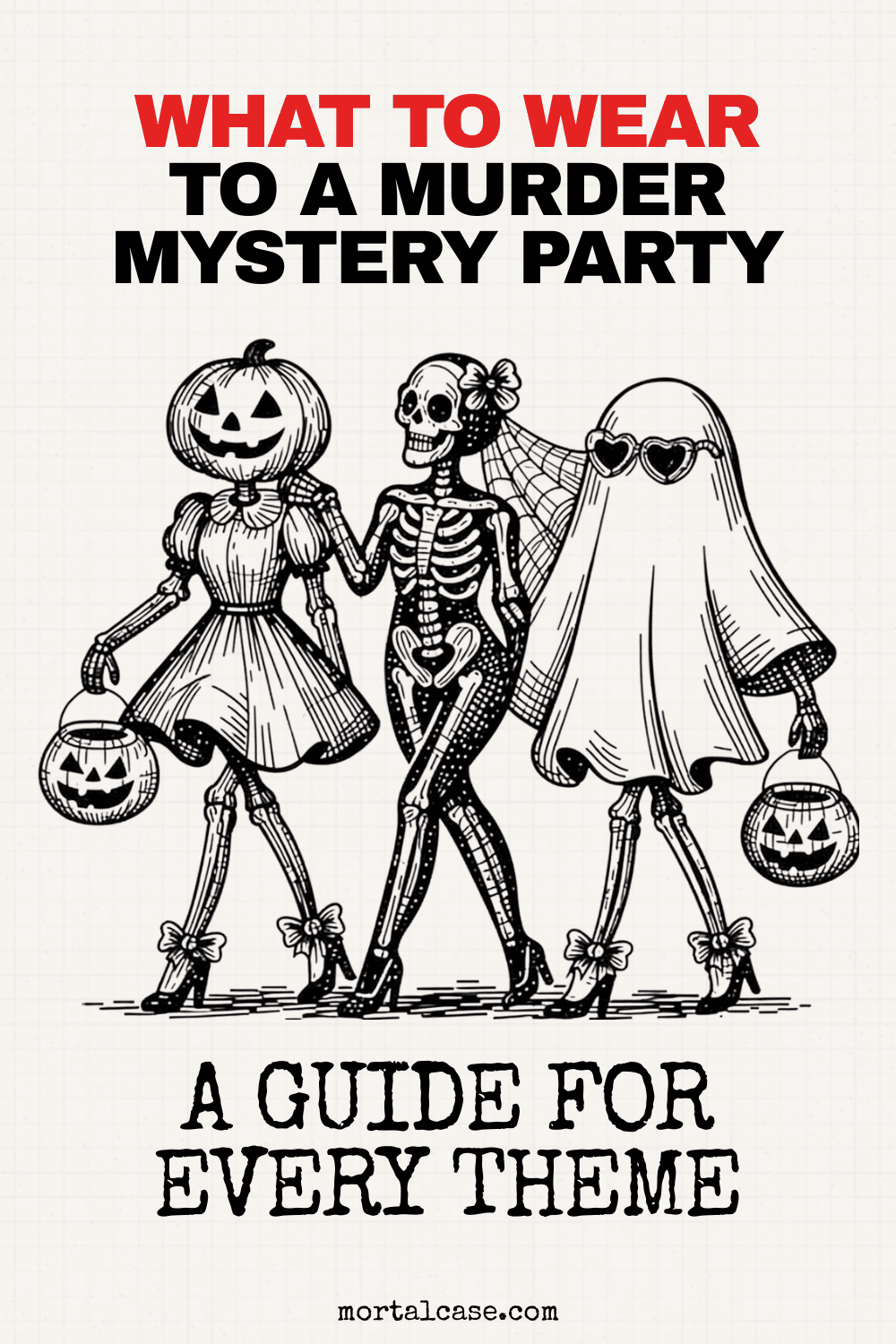
Halloween is the easiest theme for costume enthusiasm and the easiest theme to overcomplicate. For Murder Among Monsters, guests can lean into recognizable monster language: capes, horns, ears, bandages, dramatic collars, monster makeup, black clothing, old-fashioned dresses, or one playful supernatural detail.
The costume doesn’t need to become a full special-effects project. A strong color palette, a little makeup, and one clear accessory can establish a vampire, ghost, witch, werewolf, skeleton, or other creature quickly.
Keep the character underneath the monster. A monster who works as a mayor, nurse, performer, socialite, servant, or professional should still show something about that role. Planning the whole evening around October takes a little more, so start with how to host a Halloween murder mystery party.
What to wear to a monster masquerade murder mystery party
A monster masquerade can move away from playful Halloween and toward gothic formality. Think:
- Black, burgundy, deep purple, forest green, silver, or antique gold
- Velvet, lace, satin, brocade-inspired patterns, or dramatic tailoring
- Masks that can be lifted or removed during conversation
- Capes, gloves, ornate jewelry, dark florals, or elegant monster details
- Formal clothing with one supernatural element rather than a complete creature suit
Monster Mansion: The Masquerade suits guests who enjoy a darker, more polished look. The best outfits suggest that everyone belongs at the same dangerous gathering while leaving room for each character’s status, alliances, and personality. A simple black outfit, one elegant mask, and one character-specific detail can be enough. When you’re ready to look at the room instead of the wardrobe, here’s how to plan a monster masquerade murder mystery party.
What to wear to a Christmas murder mystery party
A Christmas murder mystery can use the clothes guests already wear to holiday gatherings, then turn the theme up or down. Possible directions include:
- Holiday cocktail clothing in red, green, black, gold, silver, or winter white
- Velvet, sparkle, tartan, knitwear, bows, or festive jewelry
- Ugly sweaters for a playful group
- North Pole, workshop, winter, or holiday-party details when they suit the character
- One humorous accessory for guests who want an easy option
Who Killed Santa’s Wife? gives you permission to make the room festive without requiring every guest to dress as an elf. Holiday employees, relatives, visitors, professionals, and suspicious party guests can all belong in the same world.
Decide whether your night is cozy, comic, glamorous, or full North Pole before you send the dress code. “Christmas costume” can mean 4 completely different wardrobes. You’ll have more to juggle in December than in June, and the extra planning is in my guide to a Christmas murder mystery party.
Use props that help the guest play
The best costume prop does more than fill a hand in a photograph. It can help a guest begin a conversation, remember the role, or signal something about the character. Useful props are usually:
- Small enough to carry or wear
- Safe in a crowded room
- Easy to put down
- Clearly connected to the role
- Not confused with official evidence
A notebook, fan, clipboard, camera strap, lanyard, deck of cards, costume jewelry, gloves, harmless tool pouch, or themed name badge can work beautifully. Be careful with prop letters, bottles, money, keys, weapons, documents, or mysterious objects. If they resemble the game’s evidence, guests may spend 20 minutes investigating something you bought at a thrift store because it matched the curtains. Tell guests that personal props are for character flavor and shouldn’t be presented as official clues.
Also give them a place to put things down. A prop that needs to be carried for 3 hours will eventually become the host’s prop.
What if a guest dislikes the assigned look?
A character role isn’t a command to wear a specific kind of clothing. Guests can interpret the role through color, shape, accessories, occupation, or attitude. They don’t need to copy a stereotype. They also don’t need to wear clothing that feels uncomfortable, revealing, gendered in the wrong way for them, or complicated to recreate.
Gender-neutral characters are written into the cast of a MortalCase game, and a guest can also play across gender when that feels comfortable for them. The outfit can focus on the role rather than trying to perform gender through clothing.
Do not rewrite character names, pronouns, relationships, or evidence casually to make the costume easier. Those references can appear across several files. A flexible outfit is safer than an improvised rewrite of the mystery. When a guest hesitates, ask: “What version of this character would feel fun for you to wear?” That usually opens more useful possibilities than handing them a picture and asking them to reproduce it.
Send costume guidance after the character assignment
The invitation should explain the general dress code. The character message should make it personal. You can send this with the Character Guide:
Your costume is optional and doesn’t need to be historically perfect. Start with something comfortable, add one detail that fits the theme, and use your role or the Prop Suggestions in your Character Guide for inspiration. Please keep any personal prop clearly separate from the official game evidence. For a more costume-focused group, adjust the first sentence:
Costumes are strongly encouraged, but you can choose your own effort level. A full character look is welcome, and a simple base outfit with one strong theme detail works too. For a low-pressure group:
No costume is required. Wearing the party colors or adding one small theme-inspired accessory is more than enough.
The host doesn’t need to send shopping links, build individual mood boards, or approve every outfit. Give guests a clear level, a simple formula, and their private character material. Let them interpret the rest.
A last-minute costume can still look intentional
Someone will forget. Someone will decide the night before that the original plan is uncomfortable. Someone will arrive directly from work. One of them will message you from a store to ask whether a red scarf can represent the entire 1970s. Use the emergency version of the 3-piece formula:
- Choose a neutral base, such as black, denim, white, or one party color.
- Add one borrowed or easy-to-find theme signal.
- Add a handwritten badge, small prop, or accessory that suggests the role.
Keep a small host basket only if it reduces work. Useful emergency pieces might include:
- Simple costume jewelry
- Sunglasses
- Scarves or bow ties
- Plain masks
- Name badges
- A few safe role props
Do not build a backup costume department for 20 adults. A forgotten costume doesn’t break the game.
The guest still has a Character Guide, relationships, secrets, information to share, and a Secret Task. The outfit helps the fiction. It isn’t the fiction.
The costume standard I would use for a first party
I would make costumes encouraged, not mandatory, and tell guests that one clear theme detail is enough. The general expectation goes out with the invitation, and a shorter reminder goes with each Character Guide. Ask guests to prioritize comfortable shoes, clear vision, easy movement, and props that don’t resemble evidence, then give them the 3-piece formula:
- A comfortable base outfit
- One theme signal
- One character clue
I wouldn’t require historical accuracy, make guests buy something new, or ask everyone to send me photographs for approval. Keep a few simple accessories available for the person who arrives without a plan, and then you can stop managing the wardrobe.
The guests have roles to play, people to question, secrets to hide, and 3 murders to investigate. Once they enter the room, the best costume is the one they can forget about while they become suspicious.
What should you wear to a murder mystery party?
Wear something comfortable enough for a moving, mingling party. Add one clear detail that places you inside the theme. Finish with one clue that suggests your character’s role, personality, or status.
Go simple if that makes you more willing to participate. Go elaborate if creating the look is part of the fun. Borrow, thrift, improvise, or use what you already own. Keep your face visible, your hands reasonably free, and your props separate from the evidence. You don’t need to win a costume contest to become the character. You need enough of a visual nudge to step into the room, find the first important relationship in your guide, and begin asking questions.
After that, the suspicious behavior will take care of the rest. Nobody has ever needed the right jacket in order to lie convincingly about where they were.
Choose a mystery your guests will want to dress for
Browse the MortalCase Murder Mystery Games and find the decade, setting, and cast that will give your group an immediate place to begin.